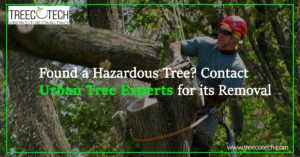
Found a Hazardous Tree? Contact Urban Tree Experts for its Removal

A tree is termed as hazardous when it can pose danger to men and materials around them. This danger could be minor injuries, damage to property or even death of living beings around the hazardous tree. A tree becomes dangerous because of the defects in it which leads to its breakage or fall. In the event of the fall, the broken limbs, fallen branches or tree trunk can hurt men, animals, and materials around causing loss of life and property. To avoid such losses, it is very essential to identify a hazardous tree in your near vicinity or within your property. You may avoid a hazardous tree in the jungle but avoiding one in the city is not a wise idea. Spot a hazardous tree soon and hire a tree arborist in Mumbai to guide you on how to proceed. For identifying a hazardous tree, the following points can help you:
• Branches: If the branches of a tree fall in minor wind or storm or if the branches can be easily broken then it is a sign of a hazardous tree.
• Dead tree: Merely the sight of the tree will itself tell you that the tree is dead. It may appear black-brown, dull and bare (without leaves). The decaying trunk is also indicative of a dead tree.
• Forked trunks: If the tree trunk is bifurcated into two similar branches it is called forked trunk. Forked trunks will produce a hazardous tree especially when the fork is growing sideways or when it is narrow as narrow forks are prone to infections.
• Root decay signs: Growing mushrooms and too many insects on the tree are signs of decaying root. If you find them, immediately get appointment with arboriculture expert to seek the right advice.
• Leaves: A tree that does not bear dense canopy and new fresh leaves may be dying and thus can prove to be hazardous if not saved in time.
If you are still doubtful about a particular tree around you that whether it is hazardous or not then call for a certified arborist in Mumbai. A tree arborist in Mumbai can skillfully identify a hazardous tree and will brief you about tree pruning techniques as may be required to apply on the tree. The arboriculture consultancy in Mumbai can do the task for you. It is essential not to try tree removal on your own because it is a big task and needs special knowledge, tools, and expertise which only a certified arborist service in Mumbai can offer. The plant health care services remove only the dead and hazardous trees and if a tree can be saved then the tree health care services will guide you for safe tree retention and protection strategies following which you may be able to save an unhealthy tree. Thus, to save yourself from a hazardous tree or to save an unhealthy tree, it is best to take the advice of tree care experts in Mumbai.
Go Green: Conduct A Tree Survey in Your School or College

Go Green Conduct A Tree Survey in Your School or CollegeSchools can provide a beautiful ambiance to the students for learning by giving space to trees in planning and development of the school premises. Besides giving a fresh environment, the presence of trees will also inculcate a love for nature in students. As students need to realize the importance of trees in our life, they should also be aware that this relationship is two ways. This implies that just like trees give us oxygen to breathe we should also take good care of trees around us so that they can live a healthy and long life. These values can be inculcated in students only when the school authorities practice them on their own. So, similar to other important jobs of the school, taking care of surrounding trees and trees or plants within the school is equally important. The schools can seek the help of tree health care services for keeping surrounding trees healthy. Such plant health care services send a certified tree arborist in Mumbai to conduct tree surveys for schools and colleges as requested. 

An astute tree arborist in Mumbai ensures to conduct a thorough survey of school/college premises and accordingly suggests tree survey compliant measures. Such a survey and suggested measures help to know about your plant health and take the necessary steps to improve the health of a tree and to adopt safe tree retention and protection strategies. Thereafter, the school/college can instruct concerned staff members to follow the measures suggested by arboriculture consultancy in Mumbai. Else, they can regularly call for a specialist from a certified arborist service in Mumbai for giving plant health care services to the trees within or outside the premises of the school or college. 

Schools need to take a tree survey not only for aesthetic reasons and inculcating values in children but also because it may be a legal obligation for them to make sure that all trees in school/college are safe for students, parents, visitors and school staff. For the sake of safety and health, schools should immediately get an appointment with arboriculture expert if:

  • A tree at the school/college property is leaning in one direction. It is likely to fall eventually and can hurt people around. Thus, it needs appropriate action soon.
  • A tree is obstructing the way in the playground or pathway and posing threat to students, staff, parents, etc. 
  • Nearby trees are a hindrance while extending the school playground. 
  • A tree in school is infected in any way and becoming a source of infection for other trees around.
  • A tree is bearing too many unwanted insects as it could be a sign of unhealthy tree calling for treatment or removal. 
  • Branches are falling. It can be a sign of a dying tree and needs immediate action by urban tree experts so that the tree doesn’t hurt any passer-by. 

When the school or college seeks services of a tree company in Mumbai, they can rest assured about the complete health care of trees and plants on their premises. The schools and colleges should religiously adopt measures suggested by the tree arborist in Mumbai post taking a survey. 

Fun Facts About Trees That Everyone Should Know

Fun Facts About Trees That Everyone Should KnowThe importance of trees in our lives cannot be emphasized enough. Since childhood, we are taught about their importance and that they give us food, shelter and life to wildlife. Other most crucial job that the trees do is to clear out the carbon dioxide from the atmosphere and release more oxygen. They are a beautiful creation of god and it is worth studying them in great detail. The fun facts below should be known to everyone, even those who do not have any arboriculture knowledge.

  1. Trees don’t die of old age:
    As per the data collected so far, it has been observed that the trees are the oldest living organisms on this earth. They don’t die if they grow really old. There are trees which are thousands of years old and still surviving! Organisations across the world are maintaining databases for tracking the age of the trees. Old trees are now preserved in most areas, thanks to environmental awareness. Tree specialist in India can help you in identifying the age of the tree.
  2. They need a lot of water, just like humans!
    Trees drink plenty of water every day. They can extract even hundred gallons per day from the ground below. Where does all this water go? The trees release it in the form of oxygen and water vapours. This whole process of consumption and release is dependent on various factors like type of the tree, location and environmental conditions.
  3. If trees and shrubs are placed at the right position in your home, then you can save up to 25% of your total electricity bills. They provide shade and can keep the home so cool that you wouldn’t require an air conditioner. A certified arborist in India can help you identify which location would be ideal.
  4. There are ‘moon trees’ on earth which were grown from about 500 seeds which were taken for orbiting the moon by Apollo 14 mission! That was in the year 1971. The seeds did not land on the moon though.
  5. Trees communicate with each other, especially when there is an external attack. It has been observed that when insects start their attack on the tree, it releases a chemical in the leaves for defence purposes. It also informs about the attack to other trees so that they can be prepared as well. It is good to know since tree safety is important to all of us!
  6. Pollens are shed by male pine cones and with the help of wind, those pollen reach the female pines cones where the pollination happens.
  7. Trees help in lowering the overall air temperature by evaporating the water.
  8. They also do the job of improving the quality of water for us. They slow down the rainwater going into the ground and save the aquifers.
  9. If you walk in the woods and get lost, trees can give you some direction! The moss and thick rings are more on the northern side.
  10. Different parts of the tree grow in different seasons. The tree doesn’t grow altogether.

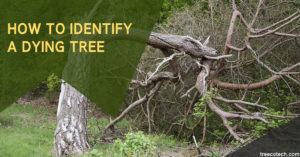
How to Identify a Dying Tree

Arboriculture training in Mumbai

Maintenance of trees is not an easy task to do. Trees, just like humans, needs regular attention and care. If they are sick, there are signs that you can read to identify their sickness. Having Arboriculture training can surely help in reading these signs since planning and development of trees is way too hard for naïve people. Even though you don’t have enough knowledge about the maintenance of trees, you can still try to find out whether the tree is dying by looking out for the following signs:

  1. Observing the trunk:
    Normally, when a tree is dying, it develops some vertical cracks in the trunk. You might also notice that the bark is missing from some areas. It could also be presence of dead bark or removed portion of it. There could be presence of Cankers too. These factors are visible from naked eye but they are easier to identify by a certified arborist in India. Other signs of trunk can be seen only if you go close and scratch it. If the inner layer of the bark has turned brown, it means that the tree is already almost dead. 
  2. Signs from the branches:
    Branches lose hold of the leaves during an incorrect season if the tree is dying. If the leaves are falling in autumn, it should be okay but if they falling out at an abnormal pace and time, then it is not a good sign. Make sure that the measures for tree safety are in place so that there is no external danger for the trees. Other signs that you can look out for are presence of dead leaves on the branches. The joints that connect the tree with the branches might turn weak and are prone to breaking with a little effort. In the growing season like spring, if the leaves are still brown in colour and brittle, then that could also be a sign of a dying tree. 
  3. Signs from the roots:
    If the roots of the tree are damaged, it will affect the whole tree and it might lean on some specific side. You will also be able to notice some little branches coming out from the base. If  you can see slimy roots, then it is also a nearly sure sign of tree decay. In the Arboriculture training programmes, the knowledge about these kinds of signs is also given.

There are other generic things like presence of fungus which can mean that the tree is rotting from the inside. In fact, not just fungus but creatures like bark beetles, ants or other insects generally thrive on dying trees. Any tree specialist in India can read these signs very quickly, just by looking at the tree.

Understanding of these signs can help you to save the tree from dying in some cases or in its timely removal before it causes any damage to the property or people nearby. A Treecotech Arboriculture specialist can help in noticing such signs.

No Arborists Just When You Need Them

MMRCL began cutting trees despite having no arborist on board to oversee the operation. Singapore-based Rick Thomas and Mumbaikar Vaibhav Raje, who was attached to MMRCL, have both left – Thomas in June 2018 and Raje in August this year.

 In an email to Mumbai Mirror, Thomas, director of consulting firm Arbor-Culture, confirmed that his contract with MMRCL had expired. “It [his contract] was in operation for one year and MMRCL has not approached me for extension or renewal,” he said. 

In June 2017 MMRCL claimed that it had appointed Singapore-based arborist Simon Leong to oversee a tree management plan for the Colaba-SEEPZ Metro 3 project – a claim Leong denied. MMRCL then hired Thomas, who, it claimed, visited all sites and conducted training workshops for contractors. 

Raje was associated with the Metro 3 project from 2015. “I was on a contract with MMRCL and after August this year, I’m no longer working with them,” he said, refusing to comment further. 

Raje, a graduate in horticulture from the Dr Balasaheb Sawant Konkan Krishi Vidyapeeth in Dapoli, is the only arborist in the city with a qualification from the International Society of Arboriculture in the US. 

Green activists said felling and transplanting trees without consulting arborists was not advisable. “MMRCL is in a hurry to cut the trees. This is when arborists are required. The survival rate of transplanted trees is poor. MMRCL should have taken on board top arborists before felling the trees,” said activist Zoru Bathena.

An official from the BMC’s Garden Department said the trees would be cut under the supervision of horticulturists appointed by the MMRCL. “We have been told that the contractors appointed by the MMRCL have horticulturists on board and the MMRCL also has a horticulturist. But beyond that we don’t know if they have any arborists,” he said. 

When contacted SK Gupta, Director, Works, MMRCL, said he did not want to comment on the issue and asked Mumbai Mirror to get in touch with the PR team.

Vaidehi More, PR consultant with MMRCL, did not respond to calls and text messages. 


source:- https://mumbaimirror.indiatimes.com/mumbai/other/no-arborists-just-when-you-need-them/articleshow/71461165.cms

Urbanization Affecting

How is Urbanization Affecting the Health of the Trees?

Urbanization Affecting the Health of the TreesIn a city like Mumbai, construction and renovation is an ongoing activity. City wide, upgrades are always going on and new housing societies are always under construction. Making way for new housing societies is important to cater to the needs of growing population, all this has a major impact on the trees and greenery around the localities where construction is done. There is some obvious damage to the trees which cannot even be ignored. But there are lot of other things that can be done to avoid the damage and let the trees survive along with the urbanization. Trees in planning and development suffer the most in different ways:

  1. Construction activities damage the health of the trees by giving them exposure to toxic substances. Some of the activities demands the trees to be removed altogether, for example building additions or installation of new structure like a pool. Creating the foundations of the buildings and even creating large pavements or broadening the roads have a direct and deteriorating effect on the trees. These activities should be tree survey compliant, but mostly, they are not.
  2. The effect of all the construction and building activities can be seen visibly most of the times, but there is some internal damage as done. The soil gets affected internally which can cause slow decay of the trees. Some of the visible effects are damage to the bark which gets scraped, the branches gets broken due to presence of machinery on the site, the roots gets exposed because of digging activities and other issues like compaction. Tree decay detection is very important to do on the site of the construction and should be the responsibility of authority who is getting that construction done as well as a check my local Municipal board.
  3. The exposed branches can catch the infections and insects which can be dangerously harmful for the trees. When the trees are partially broken or when their roots are weaker, then it will make them more susceptible to complete breakage in times of storms or heavy rains. They lose the ability to have a strong hold on the ground and can break easily. Some of the things can be predicted and avoided if the arboriculture impact assessment is done prior to getting the construction started. A willingness to save the tree can save a lot of them. Sometimes the effects are not seen immediately but they come up over time.

How can we avoid the damages?

  • The waste or construction material should never be piled on the roots.
  • Safe Tree Retention & Protection Strategies should be adopted, like putting a fence near the trees so that no vehicles gets close to them.
  • The digging should be done away from the roots. If this is not possible, then cutting that part of the root is better than leaving it injured and exposed.
  • Instead of letting the vehicles damage the trees, we can use the tree pruning techniques to make way for the vehicles.

Careful evaluation of the site and doing the assessment can save lot of trees, even in this urban world.

About Treecotech

‘TREECOTECH’ – a first-of-its-kind organisation in India dedicated to provide full scale Arboriculture Consultancy services catering to all government, semi-government, private entities like corporates, architects, project management consultants etc.

+91 99204 86396

Contact Form

    Instagram Feed